

The global renewable energy sector attracted over $620 billion in investment during 2025, and specialized investment companies have emerged as the critical infrastructure connecting capital to clean energy projects. These firms range from dedicated green energy funds managing billions in wind and solar portfolios to private equity giants launching climate-focused divisions. Understanding how these companies evaluate opportunities, structure deals, and generate returns has become essential for anyone looking to participate in the energy transition, whether as a project developer seeking funding, an institutional investor allocating capital, or a professional navigating career opportunities in sustainable finance.
Renewable energy investment companies operate across a spectrum of strategies. Some focus exclusively on utility-scale solar and offshore wind farms, acquiring operational assets that generate predictable cash flows. Others specialize in early-stage ventures developing breakthrough battery technologies or green hydrogen infrastructure. The largest players now manage portfolios exceeding $50 billion, with dedicated teams assessing everything from grid interconnection risk to long-term power purchase agreements.
The distinction matters because each company type serves different needs within the ecosystem. A pension fund seeking stable, inflation-protected returns will partner with firms emphasizing operational assets and long-term contracts. Conversely, venture-backed startups developing next-generation solar panels require investors comfortable with technology risk and patient capital horizons. Geographic focus varies too, with some companies concentrating on established markets like Europe and North America while others target high-growth regions across Asia and Latin America.
What sets successful renewable energy investment companies apart in 2026 is their ability to navigate increasingly complex market dynamics: rising interest rates affecting project economics, supply chain constraints for critical components, and evolving policy frameworks that can make or break investment theses.
Understanding the Renewable Energy Investment Landscape
Renewable energy investment companies have evolved from niche venture players into sophisticated asset managers overseeing billions in infrastructure capital. This shift reflects the sector’s maturation from experimental technology to bankable, long-term assets that appeal to institutional investors managing pension funds, insurance portfolios, and sovereign wealth.
The renewable energy investment landscape now operates across multiple capital deployment strategies, each serving distinct project lifecycle stages:
- Venture Capital
- Early-stage financing for unproven technologies and startups, typically involving higher risk but potential for outsized returns as innovations move from lab to market.
- Growth Equity
- Capital for scaling companies with proven business models, funding expansion into new markets or production capacity increases without requiring majority ownership.
- Private Equity
- Majority stake acquisitions in established renewable businesses, often involving operational improvements and strategic repositioning to increase asset value before eventual exit.
- Infrastructure Investment
- Long-term capital allocated to built, operational renewable assets like solar farms and wind parks that generate predictable cash flows over decades.
- Asset Management
- Ongoing oversight and optimization of renewable energy portfolios, balancing risk, performance, and returns across diverse technologies, geographies, and ownership structures.
Firms like Energy Impact Partners exemplify this multi-strategy approach, deploying over $4.5 billion across venture, growth, private equity, and credit instruments from offices spanning New York, San Francisco, London, Cologne, and Oslo. Their geographic reach enables portfolio diversification across regulatory environments and resource availability.
Asset management has become central to renewable energy scaling because the sector now requires capital measured in trillions, not millions. Pension funds and institutional investors need renewable infrastructure as a distinct asset class offering stable, inflation-protected returns. Recent transactions illustrate this shift: First Reserve and Fortress Investment Group’s 2026 acquisition of Island Energy Services focused not on unproven technology but on accelerating renewable fuel capabilities within Hawaii’s established fuel logistics network, treating energy transition as infrastructure optimization rather than speculative venture investing.
This asset management framework transforms how renewable energy reaches scale, channeling patient institutional capital into long-lived infrastructure while venture funding continues supporting breakthrough innovation at the technology frontier.

Major Players in Renewable Energy Investment Companies
Global Infrastructure Specialists
Global infrastructure specialists represent the most sophisticated tier of renewable energy investment companies, deploying multi-billion dollar portfolios across continents through diversified financial instruments. These firms distinguish themselves through scale, global reach, and the ability to invest across the full renewable energy development spectrum, from early-stage venture capital to mature infrastructure credit facilities.
Energy Impact Partners LP exemplifies this comprehensive approach, managing over $4.5 billion in assets under management while maintaining a truly global operational footprint. The firm’s Energy Impact Partners offices span New York, San Francisco, Washington D.C., Atlanta, Palm Beach, London, Cologne, and Oslo, positioning the company to access renewable opportunities across North America and Europe’s most active markets. This geographic diversification enables the firm to capitalize on regional policy incentives, technology clusters, and grid modernization initiatives that vary dramatically by jurisdiction.
The multi-stage investment model employed by these specialists creates strategic flexibility. Rather than confining capital to a single instrument, firms deploy venture funding to early-stage storage technology companies, growth equity to scaling solar developers, private equity to established wind farm operators, and credit facilities to refinance operational renewable assets. This approach captures value throughout the project lifecycle while managing portfolio risk through stage diversification.
| Investment Firm | Assets Under Management | Geographic Presence | Investment Stages |
|---|---|---|---|
| Energy Impact Partners LP | $4.5+ billion | 8 offices across North America and Europe | Venture, growth, private equity, credit |
| Infrastructure Pension Funds | Varies by institution | Global mandate focus | Private equity, infrastructure debt |
| Specialized Renewables Trusts | Publicly disclosed | Regional or thematic focus | Operational asset acquisition |
These global specialists typically maintain dedicated sector teams with deep technical expertise in wind, solar, storage, grid infrastructure, and emerging technologies like green hydrogen. Their institutional backing, often including strategic limited partners from utilities, energy majors, and sovereign wealth funds, provides not just capital but industry connections that accelerate portfolio company growth and market access.
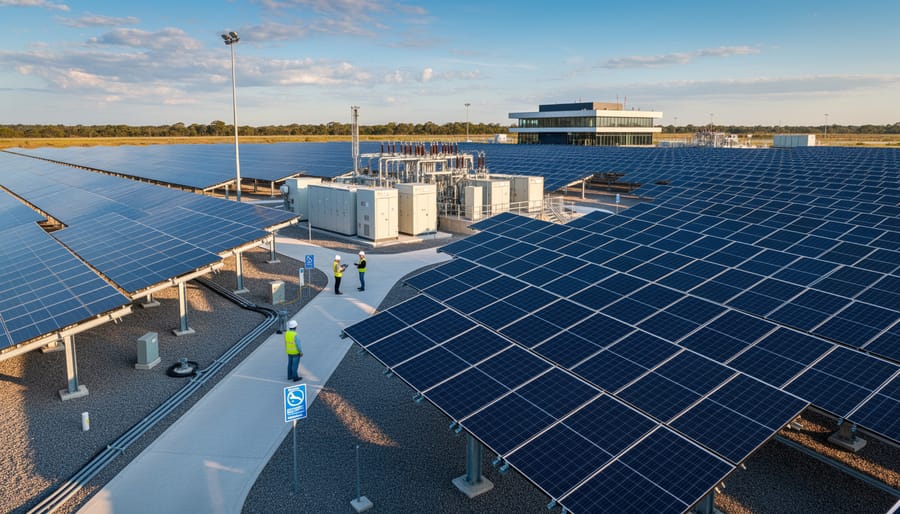
Strategic Acquisition Players
While venture capital and growth equity investors capture early-stage opportunities, a distinct class of renewable energy investment companies focuses on acquiring controlling stakes in mature infrastructure assets. First Reserve and Fortress Investment Group exemplify this approach, targeting established operational networks where they can inject capital and strategic expertise to accelerate renewable transitions. Their 2026 acquisition of a majority stake in Island Energy Services demonstrates how acquisition-focused investment firms identify existing infrastructure with renewable expansion potential.
Island Energy Services operates a fully integrated refined product import, storage, and distribution infrastructure network across Hawaii, positioning it as one of the state’s leading fuel logistics providers. Rather than building renewable infrastructure from scratch, First Reserve and Fortress recognized that IES’s existing logistics backbone could be strategically repositioned to accelerate renewable fuel capabilities throughout the Hawaiian islands. This acquisition strategy reflects a broader shift among major investment companies toward buying into operational infrastructure and steering it toward decarbonization.
The strategic logic centers on infrastructure leverage. An established logistics network eliminates years of permitting, construction, and market entry barriers that pure-play renewable developers face. First Reserve and Fortress can now deploy capital to retrofit storage facilities for renewable fuels, integrate biofuel distribution channels, and potentially incorporate hydrogen infrastructure as technologies mature. The investors gain immediate cash flow from existing operations while building optionality into emerging renewable fuel markets.
This majority-stake approach differs fundamentally from minority venture investments. Acquisition players secure operational control, enabling them to dictate capital allocation, technology transitions, and strategic partnerships. They target assets with strong market positions, regulatory relationships, and physical infrastructure that can be adapted rather than replaced. For institutional investors managing billions in renewable energy portfolios, acquiring and transforming existing infrastructure offers risk-adjusted returns that purely developmental projects cannot match.

Specialized Renewable Infrastructure Trusts
Publicly traded renewable infrastructure trusts represent a distinct category within renewable energy investment companies, offering retail and institutional investors liquid exposure to operational renewable assets. Vehicles like Octopus Renewables Infrastructure Trust plc have emerged as specialized platforms that pool capital to acquire diversified portfolios of solar, wind, and other renewable generation assets, then distribute income to shareholders from long-term power purchase agreements. The Octopus Renewables prospectus demonstrates how these trusts structure portfolios with geographic and technology diversification while maintaining transparency through public market reporting.
Institutional investors including pension funds increasingly allocate to renewable energy as a distinct asset class within their infrastructure portfolios, recognizing the combination of inflation-linked revenues, long-duration cash flows, and ESG credentials. Large Canadian pension managers, for instance, now dedicate dedicated teams to renewable infrastructure separate from traditional real estate or private equity allocations. This institutional embrace has driven capital formation at unprecedented scale, enabling the sector to compete for multi-billion dollar asset acquisitions that would have been inaccessible to venture-focused funds alone. The maturation of renewable assets into institutional-grade infrastructure marks a fundamental shift in how investment companies approach the energy transition.
Investment Strategies Driving Renewable Asset Management
Infrastructure Acquisition and Optimization
Investment firms identify mature renewable infrastructure through strategic due diligence focused on established operational networks with clear pathways to renewable conversion. The acquisition model targets assets that already generate stable cash flows from traditional energy operations but possess the physical infrastructure, market position, and regulatory licenses to pivot toward renewable fuels and technologies. Rather than building from scratch, sophisticated investors purchase proven logistics networks and then deploy capital to retrofit or expand renewable capabilities.
The 2026 acquisition of Island Energy Services by First Reserve and Fortress Investment Group demonstrates this approach in practice. IES operates Hawaii’s fully integrated refined product import, storage, and distribution infrastructure network, a mature asset with established market share. The investment thesis centered on accelerating expansion of IES’s renewable fuel capabilities within this existing logistics framework. By acquiring the complete supply chain infrastructure, the firms secured immediate operational cash flows while positioning to capture Hawaii’s transition to renewable fuels through strategic upgrades rather than greenfield development.
This optimization strategy applies across renewable infrastructure classes. Investors acquire existing port facilities to add biofuel handling capacity, purchase traditional generation assets to install innovative wind turbines on repowering sites, or take stakes in fuel distribution networks to integrate hydrogen capabilities. The approach reduces execution risk, leverages existing permits and customer relationships, and generates returns during the transition period, making it particularly attractive to institutional capital seeking stable infrastructure exposure with renewable growth potential.
Multi-Stage Investment Approaches
Sophisticated renewable energy investment companies layer capital deployment across the entire project lifecycle, structuring their portfolios to capture value from early innovation through to mature infrastructure operation. This multi-stage approach allows firms to balance risk-adjusted returns while supporting projects through critical transition phases that might otherwise stall from financing gaps.
At the venture stage, investors back nascent technologies and business models, accepting higher risk for potential transformational returns. Energy Impact Partners exemplifies this comprehensive approach, deploying over $4.5 billion across venture, growth, private equity, and credit instruments globally. As technologies prove commercial viability, the same firms often provide growth equity to scale manufacturing, expand geographic reach, or accelerate customer acquisition without forcing early exits.
Private equity becomes relevant once renewable assets generate predictable cash flows. Firms structure majority acquisitions of operational infrastructure, as First Reserve and Fortress Investment Group demonstrated in their 2026 acquisition of Island Energy Services to expand renewable fuel capabilities within Hawaii’s established logistics network. This stage focuses on operational optimization and strategic repositioning of proven assets.
Credit instruments round out the toolkit, providing structured debt for construction financing, portfolio refinancing, or acquisition leverage. This staged deployment model reduces capital inefficiency by matching investment structures to specific development phases. Rather than forcing entrepreneurs to find new investors at each inflection point, integrated firms shepherd projects from laboratory concept through decades of infrastructure operation, aligning investor timelines with the extended development cycles inherent to energy transition.
Geographic Diversification Models
Leading renewable energy investment firms manage risk and capture opportunities by maintaining operations across multiple continents, each offering distinct regulatory frameworks and resource profiles. Energy Impact Partners exemplifies this model, with offices spanning New York, San Francisco, London, Cologne, and Oslo, positioning the firm to deploy capital where solar economics favor Southern Europe, offshore wind projects scale in the North Atlantic, or battery storage regulations incentivize grid integration in North America. This geographic spread allows portfolio managers to balance regulatory risk: tightening subsidies in one jurisdiction matter less when growth accelerates elsewhere. Multi-region presence also grants access to diverse deal flows, a European office sources early-stage grid technology, while North American teams identify mature infrastructure acquisitions. By the numbers, geographic diversification doesn’t just hedge political uncertainty; it expands the universe of investable renewable assets across time zones and technology cycles, turning location itself into a strategic asset.
What Investment Companies Look for in Renewable Assets
Investment firms evaluating renewable energy assets in 2026 apply a rigorous, multi-dimensional framework that extends far beyond financial projections. The due diligence process reflects a sophisticated understanding that successful renewable infrastructure combines technical viability, regulatory alignment, operational track record, and strategic market positioning.
Technology maturity stands as the primary filter. Investors distinguish sharply between proven technologies with established performance data and emerging innovations still proving commercial viability. Solar photovoltaic installations, onshore wind farms, and hydroelectric facilities benefit from decades of operational evidence, whereas cutting-edge advancements like PV electrode coating that enhance cell efficiency require additional validation before attracting infrastructure-scale capital. Firms assess capacity factors, degradation rates over time, and maintenance requirements with particular scrutiny, often demanding third-party technical audits before committing capital.
Revenue stability and cash flow predictability drive valuation. Long-term power purchase agreements with creditworthy offtakers, favorable feed-in tariffs, or renewable energy certificate mechanisms provide the contractual foundation that institutional investors require. Firms analyze counterparty risk extensively, preferring assets backed by utility-grade contracts or government guarantees over merchant exposure to spot energy prices. The presence of inflation-linked pricing provisions and contract duration exceeding ten years significantly enhances asset attractiveness.
Regulatory and policy environments receive exhaustive examination. Investment companies map the complete incentive landscape, including tax credits, accelerated depreciation schedules, renewable portfolio standards, and carbon pricing mechanisms that affect project economics. They assess political stability, the likelihood of retroactive policy changes, and the strength of grid interconnection frameworks. Geographic diversification across multiple regulatory jurisdictions mitigates policy risk, which explains why firms like Energy Impact Partners maintain offices spanning eight cities across four continents.
Operational infrastructure and existing capabilities matter profoundly. The 2026 acquisition of Island Energy Services by First Reserve and Fortress Investment Group illustrates this focus: investors valued IES’s established import, storage, and distribution network in Hawaii specifically because it provided an integrated platform to accelerate renewable fuel capabilities. Assets with proven management teams, established maintenance protocols, and operational track records command premium valuations over greenfield development opportunities.
Scalability potential and strategic fit round out the evaluation. Investors favor assets where additional capacity can be deployed using existing infrastructure, permits, or grid connections, reducing marginal expansion costs and accelerating returns on incremental capital.

The Business Case: Why Institutional Capital Flows to Renewable Assets
Institutional investors gravitate toward renewable energy assets because they deliver precisely what pension funds, insurance companies, and sovereign wealth funds need: predictable, inflation-protected returns anchored to long-term contracts. Solar farms and wind installations typically operate under 15 to 25-year power purchase agreements with investment-grade counterparties, creating revenue streams that more closely resemble government bonds than equity markets. This contractual certainty explains why firms managing over $4.5 billion in renewable infrastructure can attract capital from conservative institutional mandates that traditionally avoided volatile technology sectors.
The financial mathematics work. Renewable infrastructure generates cash flows indexed to electricity prices and often include escalation clauses that hedge against inflation, a feature conventional fixed-income securities lack. When you combine this with debt financing available through green bonds at favorable rates and the declining cost of renewable technology, the levered equity returns frequently exceed those of traditional infrastructure like toll roads or utilities, without the demand risk or commodity exposure inherent in fossil fuel assets.
ESG mandates have shifted from optional guidelines to fiduciary requirements. Pension funds managing retirement capital for millions now face regulatory pressure and stakeholder demands to decarbonize portfolios, making renewable energy infrastructure one of the few asset classes that simultaneously meets return thresholds and sustainability criteria. Acquisitions like the 2026 Fortress Investment Group and First Reserve purchase of Island Energy Services demonstrate how even traditional fuel logistics platforms become attractive when they can pivot toward renewable fuel capabilities, allowing investors to participate in energy transition rather than fight it.
Regulatory tailwinds provide additional downside protection. Government climate commitments through 2030 create policy certainty around renewable deployment targets, grid connection priorities, and carbon pricing trajectories. Unlike speculative technology bets, renewable infrastructure investments ride structural policy support that reduces political risk and creates multiple exit options, from public market listings to strategic sales to utilities seeking to meet mandated renewable quotas.
Challenges Facing Renewable Energy Investment Companies
Despite the momentum behind renewable energy asset management, investment companies navigating this sector in 2026 face substantial operational and financial headwinds that demand sophisticated risk assessment frameworks.
Regulatory fragmentation remains a persistent challenge. Firms operating across multiple jurisdictions, such as those with offices spanning New York to Oslo, must navigate divergent policy environments where renewable energy incentives, grid connection rules, and asset classification standards shift dramatically between markets. Tax credit structures can change mid-investment cycle, directly affecting projected returns on infrastructure portfolios worth billions in assets under management.
Technology obsolescence risk complicates valuation models. Renewable infrastructure assets purchased today may face competitive pressure from next-generation technologies before fully recovering capital. Investment companies acquiring fuel logistics networks to expand renewable fuel capabilities, for instance, must weigh whether current biofuel technologies will remain commercially viable against emerging synthetic fuel alternatives or accelerated electrification timelines.
Grid integration bottlenecks create execution delays that strain capital deployment schedules. Even well-capitalized firms encounter project timelines extending years beyond initial projections due to transmission capacity constraints, interconnection queue backlogs, and utility coordination challenges. These delays compress investment windows and increase carrying costs on committed capital.
Valuation uncertainty in rapidly evolving markets poses acute difficulties for asset managers deploying capital across venture, growth, private equity, and credit instruments. Pricing mature renewable infrastructure assets requires assumptions about long-term power purchase agreement rates, capacity factors, and regulatory frameworks that may shift significantly within a decade. The lack of historical performance data for newer technologies, particularly in regions transitioning from fossil fuel dependence, makes comparable analysis difficult and increases the risk of overpaying for assets or mispricing portfolio risk concentrations.
The Future Outlook for Renewable Energy Investment
The trajectory toward 2030 climate targets is reshaping renewable asset management in ways that go far beyond solar and wind farm acquisitions. Investment companies are positioning portfolios to capture value across the entire energy transition ecosystem, with hydrogen infrastructure emerging as a major focal point. Firms with global presence, spanning continents from North America to Europe, are establishing dedicated hydrogen investment vehicles, recognizing that clean hydrogen will require infrastructure capital at a scale comparable to early natural gas buildouts.
Energy storage integration represents another frontier redefining renewable investment strategies. The EU battery value chain is attracting infrastructure capital as storage shifts from a grid-balancing tool to a standalone asset class with predictable revenue streams. Investment companies are bundling storage with generation assets to create hybrid portfolios that offer superior capacity factors and grid services revenues, fundamentally changing how renewable infrastructure is valued and financed.
Technology is transforming portfolio management itself. AI-driven optimization platforms now enable investment firms to manage thousands of distributed renewable assets as unified portfolios, optimizing dispatch strategies in real time across weather patterns, price signals, and regulatory constraints. This operational sophistication allows asset managers to extract additional value from existing infrastructure without new capital deployment.
Perhaps most significantly, the convergence of traditional energy infrastructure with renewable capabilities is creating hybrid investment opportunities. The acquisition of integrated fuel logistics networks like Hawaii’s IES demonstrates how established infrastructure can be repurposed for renewable fuel distribution, offering investors de-risked entry points with existing cash flows and optionality on energy transition upside. This convergence model will likely define the next phase of renewable asset management, as investment companies seek infrastructure plays that bridge fossil fuel certainty with renewable growth potential while maintaining portfolio stability through the transition to 2030 and beyond.
The transformation of renewable energy investment companies from specialized venture capital players into sophisticated infrastructure asset managers marks a fundamental shift in how the global energy transition will be financed and executed. Firms managing billions in assets, like Energy Impact Partners with over $4.5 billion deployed across venture, growth, private equity, and credit instruments, now operate with the same institutional rigor and scale as traditional infrastructure investors. The recent acquisition of Island Energy Services by First Reserve and Fortress Investment Group demonstrates this evolution vividly: major investment houses are targeting established fuel logistics networks specifically to accelerate renewable capabilities, treating energy infrastructure as an integrated asset class rather than isolated projects.
For project developers, this maturation of the investment landscape means access to deeper capital pools and longer investment horizons, but also heightened due diligence standards and operational performance expectations. Policymakers face a new reality where energy transition goals depend not just on subsidies and mandates, but on creating regulatory frameworks that support the asset management models now driving capital allocation. The firms with global reach, offices spanning New York to Oslo to San Francisco, bring cross-border expertise in navigating diverse regulatory environments, making policy consistency across jurisdictions increasingly valuable.
Sophisticated asset management has become the essential mechanism for deploying renewable energy at the scale required to meet 2030 climate commitments. The investment companies profiled throughout this analysis are not merely financing the energy transition; they are structuring, optimizing, and managing the infrastructure foundation on which that transition depends.